REVIEW · INARI
Muotkantunturi Park, Inari – Ice fishing and a ride on a Lappish sleigh
Book on GetYourGuide →Operated by Muotkan Ruoktu Tunturikyla · Bookable on GetYourGuide
Fishing on ice feels oddly peaceful. In Muotkan Ruoktu, you start with a traditional sleigh ride and end with a wood-fire kota cooking moment, all in one tight, family-friendly stretch. I love the small group (limited to 8) because it keeps the pace calm and the guidance personal. I also love the practical, hands-on way you learn ice fishing right on the lake. One thing to factor in: catching fish can be hit-or-miss, especially depending on when you fish.
If you want a Far North activity that feels grounded in real winter life, this one delivers. You glide through Muotkatunturi Nature Park’s silent snow world, try your luck from the ice, and then warm up with coffee, tea, and local cookies beside the fire. The wood-fire kota part is the payoff, even if the fishing is slow.
In This Review
- Muotkatunturi: why this ice fishing feels off the main trail
- What happens at Muotkan Ruoktu before you go out
- The sleigh ride through Muotkatunturi Nature Park
- Ice fishing on a frozen lake: what you actually do
- When fish luck changes
- Cooking your catch in a traditional kota by wood fire
- The guide makes the difference: Matilde, Mathilde, and real Arctic know-how
- Sami culture: present, but don’t wait for a lecture
- Northern Lights chances and seasonal magic on the way back
- Price and value: what $117 buys you in real terms
- Who should book this ice fishing and sleigh ride
- Should you book Muotkan Ruoktu ice fishing and the Lappish sleigh ride?
- FAQ
- Where is the meeting point for the tour?
- How long is the experience, and what group size is it?
- What’s included besides the sleigh ride?
- What should I bring to stay warm?
- Do I need to know how to ice fish before I go?
- Can I cook the fish if we catch some?
- Will we go out at night and see the Northern Lights?
- What happens if weather is extreme?
Muotkatunturi: why this ice fishing feels off the main trail
This isn’t a big, noisy production. It’s a short excursion built around one simple goal: get you onto the ice and into the rhythm of winter, the Sami way—patient, quiet, and outdoors-first.
You’ll be in Muotkatunturi Nature Park, in a preserved, low-light area. That matters. With no light pollution and few roads around, the night sky and the silence land differently here. And it helps set expectations: you’re not just watching winter—you’re inside it.
The pace is easy. This is not a “must be athletic” outing. It’s an experience of doing small things well: stepping carefully, learning a few fishing basics, staying warm, and sharing the moment.
What happens at Muotkan Ruoktu before you go out
Your day starts in Muotkan Ruoktu, right on Route 92 (the road to Nordkapp). Check in at the restaurant reception area; you can wait inside until departure, so you’re not standing out in the cold any longer than you have to. Parking is available on site, which is useful if you’re driving in.
From there, the tour flows like this:
- You gear up for the cold.
- You get set with the sled transport.
- You head out into the Muotkatunturi Nature Park area at the foot of the Tunturi hills.
This “warm start” matters more than you’d think. Winter activities often lose people in the logistics. Here, the schedule is built around keeping you comfortable and ready.
The sleigh ride through Muotkatunturi Nature Park
The first big experience is the ride itself. You travel in a traditional wooden sleigh, in the style used by Sami families to reach the tundra and care for reindeer. That detail isn’t just decoration. It’s the kind of practical heritage point that makes the trip feel like life in the far north, not a stage set.
As you move through snow-covered forests and valleys, the guide’s job is also to slow you down—so you notice what’s around you. In this area, there can be almost no visual “noise.” Sometimes you might even spot wildlife like a reindeer or an arctic fox.
What you’re really buying with this ride:
- Time in silence, not just time in transit.
- A gentle intro before you sit on the ice.
- A sense of being part of the landscape’s winter routine, not racing through it.
It’s also a good family fit. The ride is meant to be calm and contemplative, not intense.
Ice fishing on a frozen lake: what you actually do
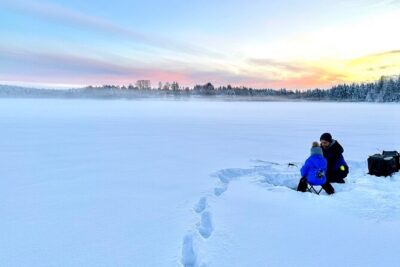
Once you arrive at the frozen lake, the tour becomes hands-on. You’ll learn how to pierce the ice and then how to fish from there. You sit on reindeer skins, which keeps you warmer than just bare seating and adds a very “this is how people really do it” touch.
Here’s what to expect in the fishing phase:
- You learn the steps for ice fishing from your guide.
- You use the provided rod and hooks (the setup is small and simple).
- You work on patience and calm rather than speed.
A couple points that make this part succeed for you:
1) Cold makes your hands clumsy. Wear warm base layers and warm socks, and keep movement gentle until you’re set up.
2) Ice fishing is not instant gratification. Your success comes from staying still long enough for the lake’s rhythm to show.
There’s also personalized support. The group size stays small (max 8), so it’s easier for the guide to check your technique and help you adjust.
When fish luck changes
One real-world consideration from the experience: fish activity can vary with conditions, including time of day and light. If you’re booked for a darker window, you might find fishing is harder and fish don’t always come up as readily. This isn’t a failure of the method. It’s just winter biology behaving like winter biology.
So I’d frame the goal like this: you’re learning and experiencing ice fishing. Catching fish is a bonus, not the whole story.
Cooking your catch in a traditional kota by wood fire
If you catch something, you’ll have the chance to prepare it in a traditional kota. This is a warm, practical structure used for winter shelter and cooking, and it turns the day from outdoors-challenge into shared winter comfort.
The key details here:
- You cook your catch over a wood fire.
- The guide supports you, so you’re not figuring out a camp kitchen with cold hands and no plan.
- You’ll already be warming up during the session with coffee, tea, and local cookies.
Even if you don’t catch fish, the kota moment is still valuable because it connects the whole experience into a Sami winter rhythm: travel out, fish patiently, and then share heat and food.
It also makes sense for photos and memories. Not every winter tour gives you a real purpose for the fire beyond looking at flames.
The guide makes the difference: Matilde, Mathilde, and real Arctic know-how
This kind of trip lives or dies by your guide. The best part here is not “big speeches.” It’s step-by-step teaching, with a warm style.
In recent outings, guides like Matilde/Mathilde have shown high energy and kept people comfortable and engaged even when the fish didn’t cooperate. One highlight was a guide-led moment that aligned with the Northern Lights while fishing—exact timing is never guaranteed, but the fact it happened at all is a nice reminder that winter skies can surprise you.
Sami culture: present, but don’t wait for a lecture
There’s a cultural layer built in. You’ll learn about Sami traditions and life in the Arctic, and the guide will explain what you’re doing and why.
Still, one practical note: the amount of culture depth can depend on you. If you want more than the basics, ask questions during setup and while you’re waiting for bites. This is especially helpful if you’re coming from far away and looking to understand more than just the fishing mechanics.
Northern Lights chances and seasonal magic on the way back
Even with a short 2-hour schedule, winter in this region can come with sky drama. The tour runs through a natural area where darkness can make the sky easier to see.
With a little luck, you may see the Northern Lights on the way back. You also get seasonal context depending on the time of year—this area is built for winter skies, not for comfort-only sightseeing.
Important expectation-setting: aurora depends on weather and night conditions, so you shouldn’t plan your whole trip around it. But if it happens, it’s perfect here, because you’re already in the ice-fishing mood.
Price and value: what $117 buys you in real terms
At about $117 per person for a 2-hour experience, the price makes more sense when you look at what’s included.
You get:
- Traditional wooden sleigh transport
- Ice fishing gear (including rods/hooks, an auger for ice prep, and reindeer skins)
- Cold-weather clothing and outerwear
- Coffee, tea, and local cookies
- Guide support and ice fishing coaching
- The option to prepare your catch in a traditional kota
- A small group format designed for both comfort and better fishing conditions
That’s the value equation. Many winter activities charge a similar amount but leave you on your own with gear or force a long time commitment. Here, the time is short and the effort is supported.
If you’re doing Lapland as a once-in-a-lifetime stop, that kind of “guided + equipped + time-efficient” setup is exactly what you want.
Who should book this ice fishing and sleigh ride
This tour fits best if you want:
- A hands-on winter activity, not a passive viewing one
- A short, gentle experience that works for couples and families
- A small-group vibe where the guide can actually help you
- A real connection to winter life through Sami winter-style fishing and traditional cooking
It may be less ideal if:
- Your main goal is guaranteed fish on the line (it’s never guaranteed)
- You want a deep, lecture-style Sami culture program rather than a practical, on-the-ground explanation
Should you book Muotkan Ruoktu ice fishing and the Lappish sleigh ride?
I’d book it if you’re trying to build a Lapland day around doing something real with your hands and then warming up in a kota. The sleigh transport feels tied to local winter life, and the ice fishing setup is designed to teach you quickly—so you’re not freezing while figuring stuff out.
Go in with the right mindset: fish luck varies, and timing/light can affect what bites. If you treat it as a learning experience with strong winter atmosphere, you’ll get your money’s worth.
FAQ
Where is the meeting point for the tour?
You meet in Muotkan Ruoktu, right on Route 92 (the road to Nordkapp). Check in at the restaurant reception area.
How long is the experience, and what group size is it?
The tour lasts 2 hours and runs as a small group limited to 8 participants.
What’s included besides the sleigh ride?
Ice fishing gear is included (including rods/hooks, an auger, and reindeer skins), plus coffee, tea, and local cookies during the tour. You also learn Sami traditions and get tips and support for ice fishing techniques.
What should I bring to stay warm?
Bring warm clothing and warm shoes. Dress for winter with winter-appropriate layers; you may provide your own base layers, while the tour provides cold-weather clothing and outerwear.
Do I need to know how to ice fish before I go?
No. You’ll be taught how to pierce the ice and fish from the lake, with step-by-step support from your guide.
Can I cook the fish if we catch some?
Yes. If you catch fish, you can prepare it in a traditional kota.
Will we go out at night and see the Northern Lights?
The tour mentions Northern Lights are possible with a little luck, including on the way back. They aren’t guaranteed.
What happens if weather is extreme?
In extreme conditions, the activity may be modified or canceled with a full refund. You also get free cancellation up to 24 hours in advance for a full refund, and there’s a reserve now, pay later option.